
500+
Websites Optimized for AI Search
320%
Average AI Citation Growth
68%
Share of Answer Across Tracked Prompts
95%
Client Retention Rate

Ecommerce GEO Is One Piece of a Bigger AI Shopping Picture:
- Ecommerce GEO
- Ecommerce SEO
- Ecommerce Paid Ads
- Perplexity SEO
- Core GEO

800+ REVIEWS

800+ REVIEWS

800+ REVIEWS

800+ REVIEWS

800+ REVIEWS
What Is Ecommerce GEO?
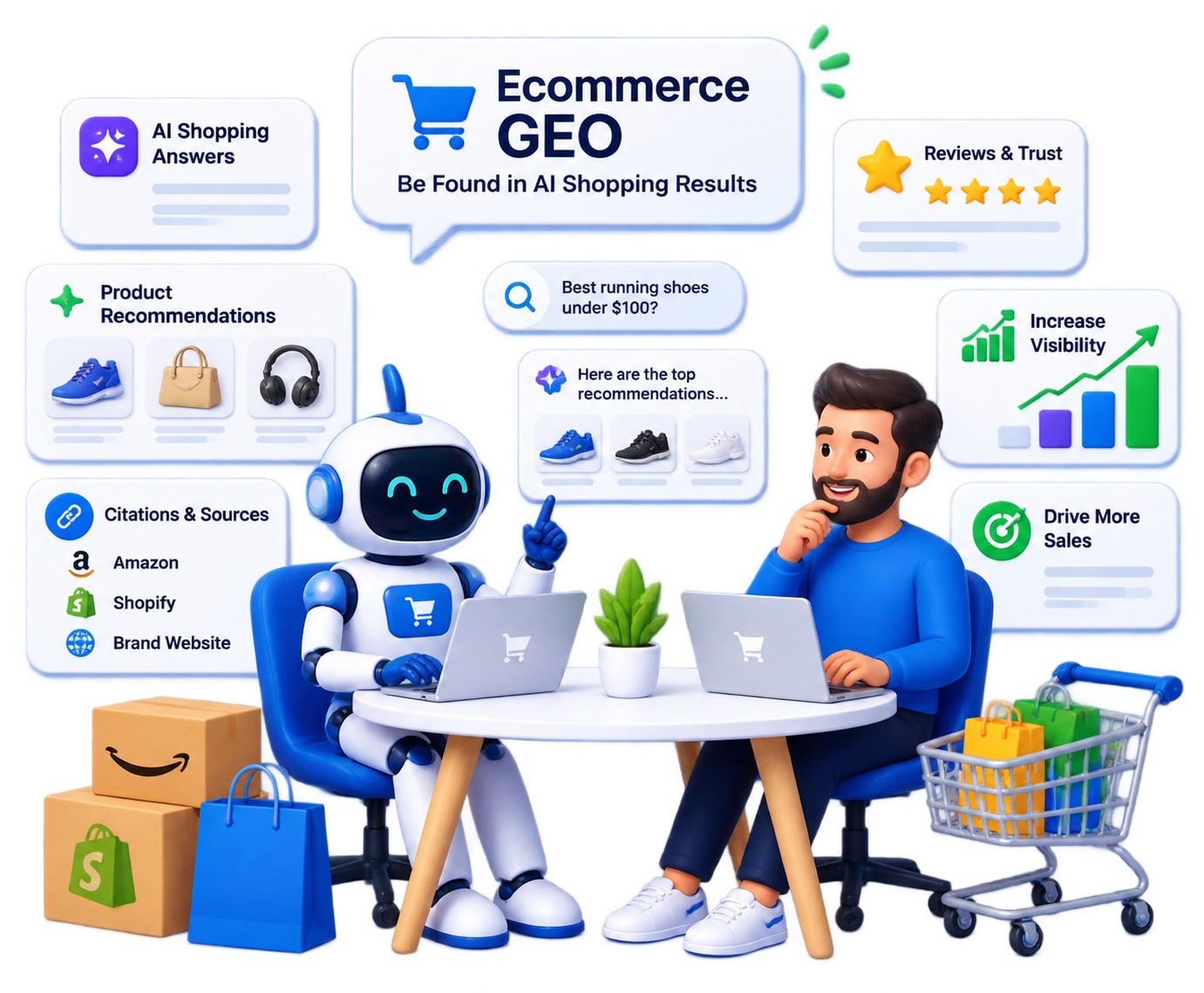
Ecommerce GEO, short for Generative Engine Optimization for ecommerce, is the practice of structuring your product catalog, content, and off-site presence so AI shopping assistants can find, trust, and recommend your products inside a generated answer. It isn’t a variant of product-page SEO. ChatGPT and Perplexity don’t have a results page to rank on; they have a recommendation to make, and your job is to be one of the products they choose.
Instead of chasing a position on a category page, the work is built around earning the AI’s trust to:
- Make sure AI shopping crawlers can actually reach, read, and index your product and category pages.
- Structure product data — price, availability, specs, and reviews, so a retrieval model can lift and quote it accurately.
- Earn mentions on the review sites, forums, and comparison pages your buyers already trust before an AI recommends you.
Objective:
“Be the product it can’t leave out of the answer.”
A Quick Comparison: Ecommerce GEO vs Traditional Ecommerce SEO vs Ecommerce Paid Ads
| Factors | Ecommerce GEO | Traditional Ecommerce SEO | Ecommerce Paid Ads |
| Goal | Get products cited, recommended, and surfaced inside AI shopping answers | Rank category and product pages prominently in traditional search results | Buy product placement and generate clicks and sales through paid advertising |
| Success looks like | Citation frequency, product mentions, recommendation share, and AI-referred revenue | Rankings, organic clicks, sessions, and ecommerce conversions | ROAS, conversions, cost per click, and revenue from paid traffic |
| What matters most | Clean product data, product feeds, reviews, schema, entity signals, content clarity, and freshness | Keywords, backlinks, on-page relevance, technical SEO, site health, and product page quality | Budget, bids, targeting, product feeds, ad relevance, creative, and campaign optimization |
| Where the user sees you | Inside AI-generated shopping recommendations on ChatGPT, Perplexity, Google AI Mode, and Gemini | Category and product listings on Google and Bing search results | Search ads, shopping ads, sponsored product placements, and other paid ad slots |
Why Ecommerce GEO Can’t Be Ignored
Product discovery now starts in chat, and AI-referred shoppers convert higher since they arrive already comparing options.
Checkout is moving into chat too. In-chat buying turns a citation into a direct sales channel, not just visibility.
Community content — Reddit threads, reviews, comparisons shapes AI citations as much as your own product pages do
Competitors already show up in these answers; every day you’re missing, a rival’s product gets recommended instead.
WebSpero’s Ecommerce GEO Framework
We built this framework around how AI shopping engines evaluate a product feed, not adapted from a generic AI-search checklist.
As your ecommerce GEO agency, we run all six steps together instead of treating any one as a standalone fix.
Step 1

Shopper Prompt & Product Query Mapping
- We test the real prompts your buyers type — “best X for Y,” “X vs Y,” “is X worth it” — not just the keywords they’d type into Google.
- Prompts get split by intent: research, comparison, and ready-to-buy, since AI engines format and cite each differently.
- Every prompt is logged with who’s currently recommended, so you know exactly where your catalog stands in week one.
Step 02
AI Crawler & Product Feed Access Audit
- We confirm AI shopping crawlers can reach your site and feed, and that no CDN or firewall rule is silently blocking them.
- Your product feed gets checked for the fields AI engines actually use — price, availability, specs, and reviews, and clearly not just what a shopping-ad feed requires.
- Page speed and rendering get reviewed too, since a slow or JavaScript-heavy product page can time out before it’s read.
Step 03
Citation Gap & Competitor Analysis
- We run your priority prompts ourselves and record exactly which products and retailers get cited, and how often.
- That builds a citation gap matrix, plus a dedicated audit of the review sites and comparison pages AI already trusts in your category.
- Wherever a competitor is recommended, and you aren’t, we treat that source as a target.
Step 04
Product Schema & Entity Optimization
- We implement Product, Offer, and Review schema in JSON-LD across priority pages.
- Pricing, availability, and specs get cleaned up so they read the same across your site, feed, and marketplace listings — inconsistent numbers cost you the AI’s trust.
- Brand and product descriptions get standardized too, since AI engines often pull “what this is” from the same sources they pull the facts from.
Step 05
Answer-Ready Product & Category Content
- Product and category pages get rewritten with a direct answer up front: what it is, who it’s for, what it costs, before the rest of the detail.
- We format with comparison tables, spec lists, and short paragraphs a retrieval system can lift cleanly.
- Where a page needs a full rewrite rather than a patch, our content writing services team handles it end to end.
Step 06
Reviews, Digital PR & Ongoing Monitoring
- We prioritize placements and reviews on the sites AI already treats as trustworthy in your category, drawing on our link building and media outreach teams rather than generic press pickup.
- Citation frequency, share of answer, and AI-referred revenue get tracked for every priority prompt, monthly at minimum.
- Any outdated price, stock status, or product detail an AI surfaces about you gets flagged and corrected at the source.
Why Choose WebSpero as Your Ecommerce GEO Agency
We’re the ecommerce GEO agency brands bring in when they want search rankings and AI recommendations working together, not competing for the same budget.
Ecommerce-First GEO Experience
Every recommendation starts from your actual catalog and reviews, not a checklist written for blog content.
One Team, Full Funnel
SEO, GEO, paid product ads, and content run together under one team, so priorities never get split across five vendors.
Proprietary Citation Tracking
Our own dashboard shows share of answer and AI-referred revenue, not just rankings.
Transparent Reporting
You see exactly which prompts and products are getting recommended, and which ones we’re still working to win.
Real Results For Ecommerce Brands
Real results from ecommerce brands we’ve helped gain visibility across organic search and AI-powered shopping.


See Why Clients Trust Our Ecommerce Expertise
We’ve made it our mission to lead by example

Kimi Verma, CEO
The clients have seen a significant increase in traffic with numbers growing into the hundreds. WebSpero is strategizing on how to take pre-existing high-traffic clients even higher. Their team is communicative and effectively follows through on directions. They took over our entire SEO division. This includes auditing sites, fixing onsite problems, improving site speed, optimizing site navigation and layout, optimizing content for conversion, fixing duplicate content and much more.
Ben Macrae, Manager
The business has seen a great improvement in backlinks and domain referrals, rankings and organic traffic. WebSpero’s communication has been great, as they keep the client updated at all times. The team’s responsiveness and expertise make them a joy to work with.
Diego Margalef, Therapist
WebSpero Solutions delivers effective digital marketing services that continue to achieve satisfying results, which enables ongoing collaboration. The team provides industry expertise and produces reports regularly to ensure transparency. They seek feedback frequently to improve their performance.
Frequently Asked Questions
01. What’s the difference between Ecommerce GEO and any other type of GEO?
It’s the ecommerce-specific side of broader Generative Engine Optimization practices: making sure ChatGPT, Perplexity, and Google AI Mode have clean enough product data to recommend your catalog by name, the same way they’d cite a source in a written answer.
02. How is an ecommerce GEO agency different from an ecommerce SEO company?
An ecommerce SEO company focuses on ranking your category and product pages in traditional search results, built around keywords, backlinks, and on-page health. An ecommerce GEO agency optimizes for a different outcome: being one of the products an AI engine actually recommends when it writes an answer. The two disciplines share some groundwork, like clean site structure and fast pages, but the content, data, and tracking each one prioritizes are different.
03. Do I still need an SEO agency for ecommerce if I invest in GEO?
Yes. Traditional search still sends meaningful traffic, and a lot of the technical and content groundwork overlaps with GEO. Most brands run both together rather than choosing one, which is why GEO is built as an extension of existing SEO work, not a replacement for it.
04. Does Ecommerce GEO work alongside paid ads?
Yes, and it should. Paid product feeds and AI-citation work typically run side by side, since a product an AI already recommends tends to convert better once it also shows up in a shopping ad. It runs alongside, not instead of, the paid media budget.
05. How long does Ecommerce GEO take to show results?
Faster than traditional SEO in most cases. Because AI engines retrieve live rather than waiting for a recrawl cycle, a fixed or newly published product page can start appearing in recommendations within a couple of weeks. Building consistent coverage across a full catalog and prompt map typically takes 60 to 90 days.
Your Competitors' Products Might Already Be the Answer AI Gives Your Buyers. Is Yours?
The window to become a trusted source is open now, while most ecommerce brands are still ignoring generative search. Book a free Ecommerce GEO audit, and we’ll show you exactly which shopper prompts your catalog is missing and what it takes to change that.